
GUIDE
Games at your office
Your office already has the people, the tables and the kettle.
Add an open space and a scoreboard. We bring the games.
Here's the space you need, the games that fit and a sample 90-minute session. Then choose who runs it.
Why the office can be the best place
Keeping the activity at the office makes it easy for everyone to join in. Travelling to another address after work takes time and energy. At the office, everyone is already there. You can avoid venue hire, start after work and have food delivered.
The office is familiar ground too. A space people know can make it easier to feel comfortable joining in.
What you need
Space. Allow roughly 1–1.5 square metres per person for everyone to stand in teams. A large meeting room, lounge, kitchen area or reception can work. Moving a few desks aside may create enough space in an open-plan office. Games involving walking or running also need a clear 5-metre stretch; a corridor can work.
Tables for some games. Quizzes, word games and building games are played in teams around tables. Allow one table per team. Regular desks or standing tables work well.
Sound. Teams can get lively. If you share a floor with another business, choose a suitable time after work or let your neighbours know. Music is a nice extra, rather than a requirement.
A quick look around beforehand. Move anything fragile away from where teams will stand. This can be as simple as clearing a few coffee cups and a cable, rather than emptying the room.
You only need a standard power point. A projector, stage and special lighting aren't required.
Which activities work indoors
Most games work indoors when chosen for the space. Here's how we can build an office session, with examples from our range of around 30 games.
As people arrive: something they can join in straight away. In Find someone who, everyone gets a card of prompts, such as 'has visited Japan' or 'cycles to work', and looks for colleagues who match. It fills the first 10 minutes while everyone arrives.
Around the tables: seated team games. Find the most words gives teams a theme, a letter and 90 seconds. Try Categories or Name that sound. In Tower challenge, teams build with straws, tape and a marshmallow. These only need tables and fit well between two livelier games.
On the floor: games needing 5 metres. In Mind the wall, a teammate steps backwards with eyes closed. Closest to the wall without touching wins. In Pen in the bottle, a team guides a colleague whose eyes are closed. These need a clear stretch and a wall without pictures.
At the front: games with an audience. In Reverse charades, the whole team acts while one person guesses. Keep talking gives someone 30 seconds on a topic such as our best office snack. Other teams listen for a slip. Allow a clear 3-by-3-metre area for a team.
Energy: games that get people moving. Musical chairs can work in an office with enough space. Relays such as Ghost relay can work in a corridor or clear aisle.
Nearly all of our 30 or so games work in an office. We leave out games that need long running lanes or outdoor space.
What to leave out of an office session
Choose gentle props around screens. Save water games for another setting. Pick games people can play standing or seated. Keep music considerate in shared buildings. Make room for people who would rather cheer than take part physically.
That last point is about choosing inclusive games. Team-based activities offer different roles: someone who prefers not to run can keep score or help with the guessing.
What 90 minutes could look like
A sample office session for 20 people in four teams:
- 0–10 min
- an arrival game as people join in
- 10–20 min
- welcome, team allocation and a quick icebreaker such as Everyone who…, where teams guess how many people in the room match a statement
- 20–40 min
- Two table-based games
- 40–65 min
- Two games on the floor or at the front
- 65–80 min
- an energetic game, then a calmer finale
- 80–90 min
- final scores and prizes
Then it's time for food. Catering at the office keeps things simple, and the group has plenty to chat about together.
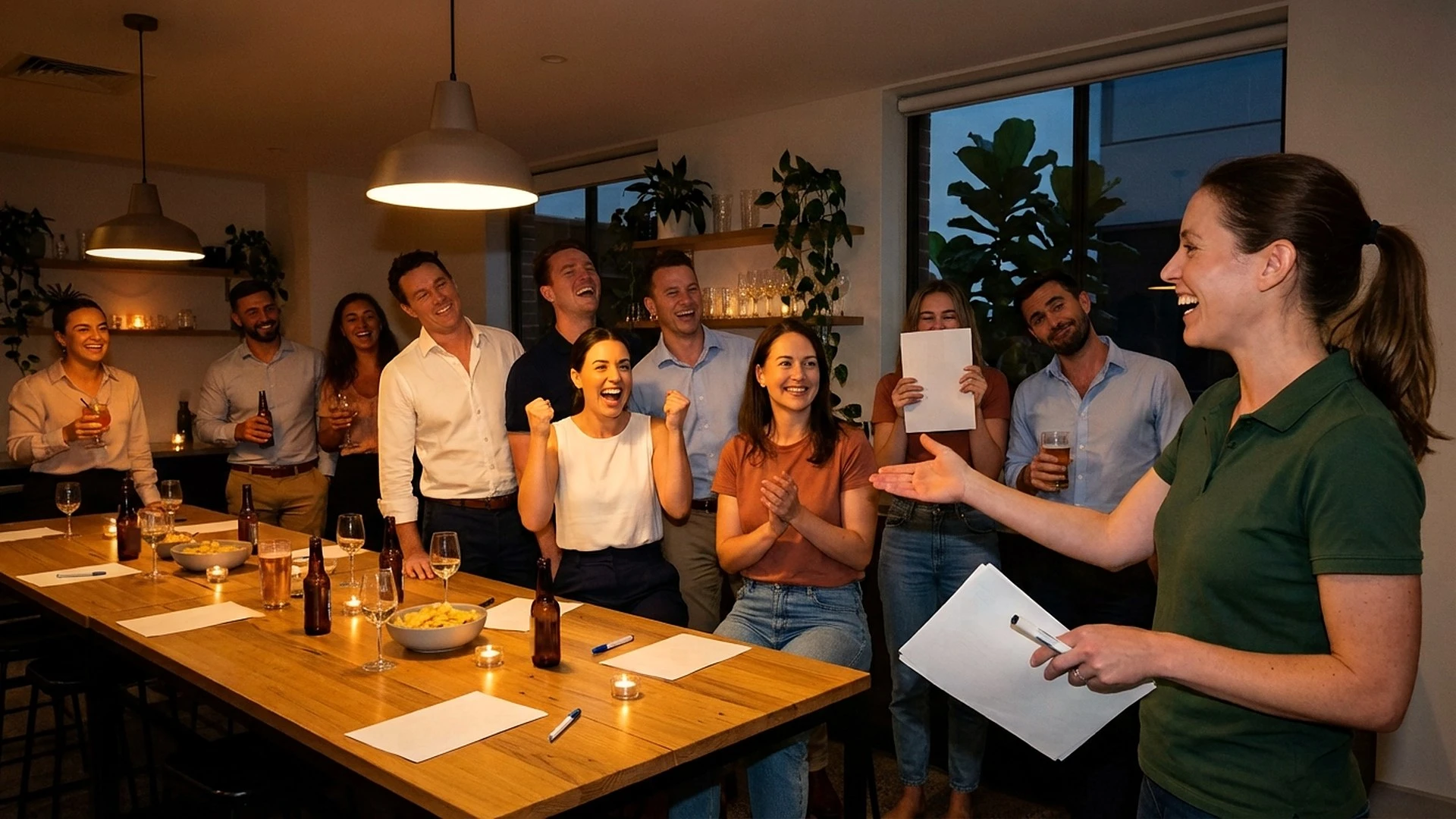
THE EASY OPTION
Or we come and run it.
For 8–12 people, you can run it yourselves. Choose a colleague who enjoys leading games and has time to prepare. The games above are straightforward to learn.
From 15 people upwards, there's more to coordinate. Someone needs to explain the rules, keep things moving, count points, settle questions and help everyone feel included. A host lets that colleague join in too. They've already handled the space, food and invitations.
A host handles the equipment, rules and scores. The person who organised the evening gets to play.
Games That Work brings a 90-minute hosted session to your Sydney office, with all games and equipment. $125 per person plus GST plus a $250 set-up fee, from 12 people. Travel within Sydney is included.
Checklist for the evening
- Choose the space you will use and decide whether anything needs moving.
- Let your neighbours know if you share a building, or choose a time after work.
- Allow one table per team.
- Clear any fragile items from the space.
- Arrange food for after the activity, rather than during it.
- Ask everyone to wear shoes they can move in. No change of clothes needed, just comfortable footwear.
- Decide who will welcome the host, if you have one.
- Have a whiteboard or flip chart ready for the scores.
- Include remote colleagues: share the start time well ahead so they can come in.
Frequently asked questions
Want to start small? Read about Friday drinks at the office.
Read also: how an activity works when everyone in the office can join in.
Read also: team games for your workplace.