
GUIDE
Games everyone can join in
20 people, plenty of different personalities.
Some want to move. Some want a puzzle. Teams give everyone a way to contribute.
Here's how different roles, changing pace and team scores make room for everyone. With games you can picture at your office.
Who to keep in mind
Most teams have at least one of each:
- The person with enough energy for 10, ready for a proper competition.
- The person watching the scoreboard from the first round.
- The person who doesn't drink, for whatever reason, and wants more than an evening centred on the bar.
- The person with a sore knee, who is pregnant, uses a wheelchair or chooses not to take on physical tasks for another reason.
- The new colleague who doesn't know anyone yet and is unsure where to stand.
- The quiet person who shines when their team needs an answer.
- The person still finding their feet in English.
- The person who is 25 years older than the average, or 25 years younger.
- The person who likes to watch the first round before joining in.
A good evening gives everyone a way to join in. Different rounds make room for different strengths.
What makes the difference
Your team, your points. Team scores make room for movement and guessing. Everyone contributes to the same result. They win or lose together. Nobody carries the result alone, and everyone has room to contribute.
Several roles in each game. Your team chooses who takes the main task. Everyone else guesses, guides, cheers or tracks the score. Those who enjoy the spotlight can take it. Those who prefer another role still contribute to the win. That's how someone who loves movement and someone who prefers to stay seated can win together.
A changing pace. A movement game, then a puzzle. Something silly, then a quick round. Around 10 minutes per game keeps things moving.
Real competition. The scoreboard stays visible all evening. Competitive players have something to aim for. Their team is ahead by 2 points, and everyone can see it.
Sometimes movement earns points, sometimes thinking does. The fastest team wins the relay. The next game rewards problem-solving. Across the evening, different strengths count, and the lead can change between game three and game seven.
Nobody goes up alone unless they want to. Some games have one person acting while the others guess, ideal for someone who enjoys it. Others have the whole team acting together. We mix them up, and teams choose who takes the spotlight.
Alcohol is optional. The games are designed to be fun without a drink. Anyone having a beer can enjoy them too.
Language. Charades, building and drawing games rely less on words. Tell us which languages your team speaks so we can choose suitable games.
What it looks like in practice
We choose from around 30 games. Here's how a mixed session can look.
For energetic players: Ghost relay, where teams move paper ghosts using straws. 1, 2, 3, stop, where three people per team sneak forward while the host looks away. Run and remember, where a runner collects information for the team to solve a task. Who am I? gets teams asking yes-or-no questions to identify the name on a teammate's forehead.
For those who like a mental challenge: In 5 seconds, where teams name three things in 5 seconds. Name that intro. Categories. Tower challenge, where teams build the tallest tower using straws, tape and a marshmallow. These games reward clever thinking, not just speed.
The whole team together, nobody alone: Reverse charades, where the whole team acts and one person guesses. Drawing showdown, with a different drawer each round. Back to back, where pairs sit back to back and one person describes a picture for the other to draw.
Your team chooses the player: In Mind the wall, one teammate steps backwards with eyes closed. Closest without touching wins. Pen in the bottle, where the team guides a colleague with their eyes closed. Someone who enjoys the spotlight can take the task. Everyone else has the key role of giving instructions.
Movement games where the team chooses: Musical chairs with two people per team in the circle and everyone else cheering. Relays where teams choose who takes part. Other teammates cheer, guess and keep track of the score.
A session combines guessing, building, drawing and thinking games with games that involve more movement. Someone with limited mobility can join in with the first group just like everyone else. In movement games, teams choose who takes on the main task while others guess, guide or take another role. Everyone has a place on the team. There are several ways to help in each round. Tell us when you book and the host can plan ahead. If your group loves competition, we can include more timed games.
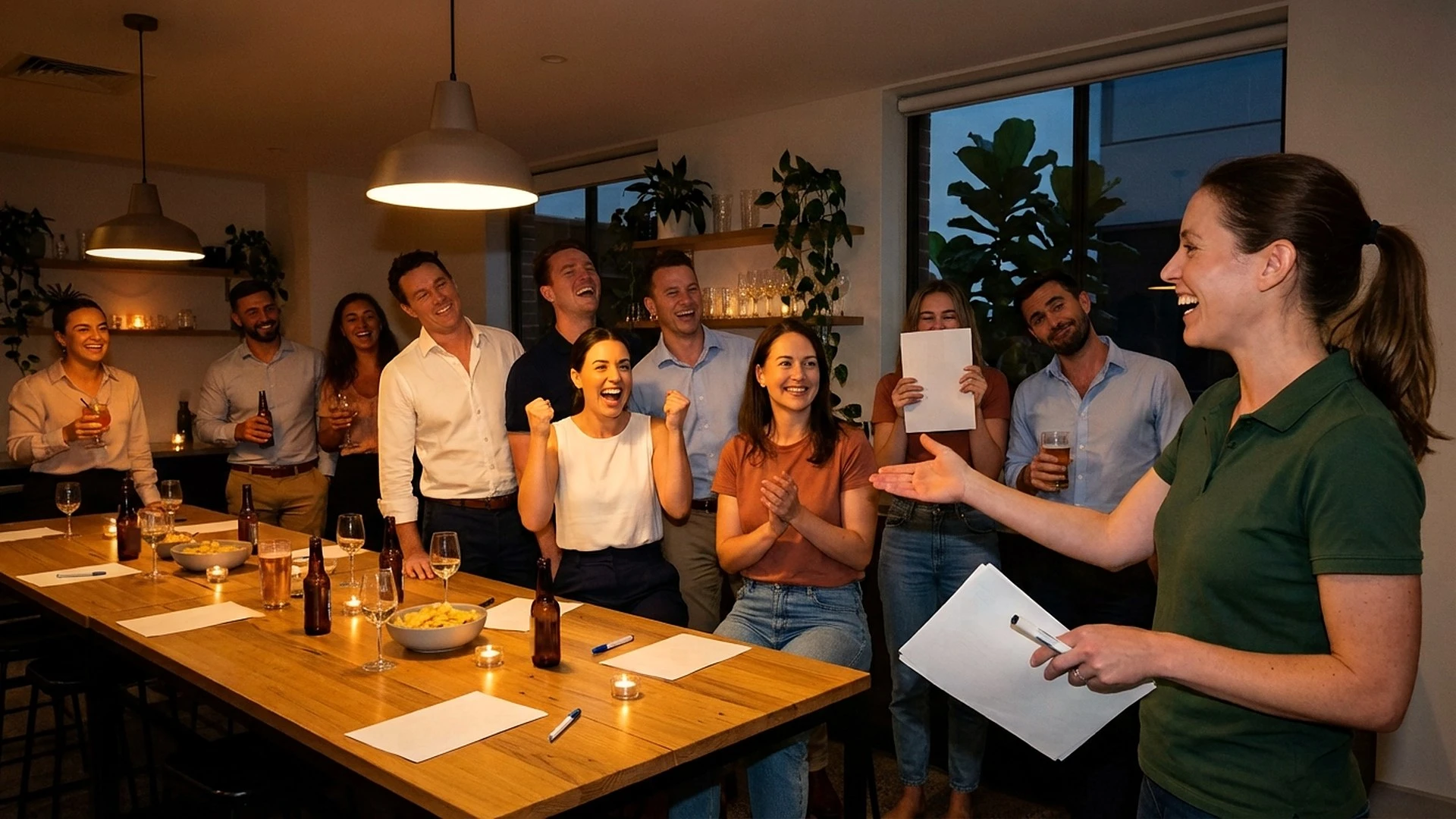
THE EASY OPTION
Or we come and run it.
This is where a hosted activity differs from doing it yourself. Our host watches the room. They help a teammate find a role, build on the energy and change the pace. They make cheering count and call out the scores so everyone knows what's at stake.
Those details make room for the person who wants to move and the person who prefers a seat.
What to put in the invitation
A line that welcomes both:
We'll play in teams and keep score throughout the evening, so bring your competitive spirit. Nobody needs to do anything alone in front of everyone. Cheering, guessing or taking another role counts just as much. Let us know if there's anything we should consider so we can plan for it.
That last part matters. People may only mention a sore knee or a language need when they're invited to.
Questions to ask before booking, whichever supplier you choose
- Are scores kept per team or per person?
- Does the pace change, or is it the same type of activity throughout?
- Does every game have a role for someone who is not doing the main task?
- How do you include someone who can't or prefers not to take part in the physical tasks?
- Does it work without alcohol?
Frequently asked questions
Read also: team games for your workplace.